

Have you been waking up in the middle of the night for seemingly no reason? Or maybe you’re getting enough sleep but still wake up feeling tired. Over time, that lack of sleep can build up, leading to long-term fatigue and making it difficult for your body to properly repair and recover.
The thing most men don’t realize is that you can log a full night of sleep and still get very little of the sleep that matters — that deep, slow-wave stage where your body does its repair work. And that stage is governed by a hormone whose output has possibly been quietly declining since your twenties. The good news is that peptide therapy might help.
How Does Growth Hormone Affect Rest & Recovery?
Your pituitary gland produces growth hormone; it’s a small structure at the base of your brain. It supports tissue recovery, protein synthesis, lean muscle preservation, fat metabolism, and bone density. Growth hormone basically handles yesterday’s damage so you can perform today.
But it isn’t released steadily throughout the day. It’s actually released in pulses, with the largest amount usually happening shortly after you fall asleep, during your first cycles of deep slow-wave sleep. The majority of your daily growth hormone release is tied to those early hours of the night.
For many men, slow-wave sleep begins declining in their late twenties and drops steadily from there, so by their forties, most men get a fraction of the deep sleep they did years earlier. This could be because growth hormone declines by around 10 to 15% per decade.
So, if you’re experiencing a decline in growth hormone, it could be causing you to have your deep sleep interrupted during the night, or you might not even be getting that full deep sleep that you need.
How Can Peptide Therapy For Sleep, Rest, and Recovery Help?
Peptides can potentially help with declining growth hormones. They’re short chains of amino acids, the same building blocks as proteins, just smaller and more specific. Your body already produces hundreds of them, and they function as signaling molecules: chemical instructions telling your tissues when to repair, when to release hormones, when to recover.
Peptide therapy uses targeted versions of these signals to restore communication that’s become less efficient with age. For sleep and recovery specifically, the relevant peptide is sermorelin.
Sermorelin is a 29-amino-acid peptide that mimics growth hormone releasing hormone (the signal your hypothalamus sends to tell your pituitary to produce growth hormone). It doesn’t add growth hormone to your system, but it does prompt your body to make more of its own.
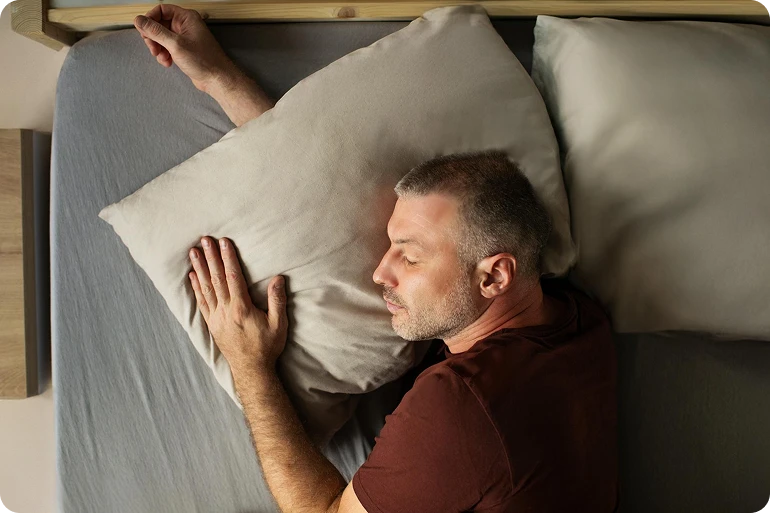
How is Peptide Therapy Different From Using a Sleep Aid?
Melatonin and prescription sedatives are aimed at getting you unconscious. Neither one restores the quality of the sleep you get once you’re there. Sermorelin, on the other hand, isn’t sedating at all. It works on the hormone signaling that makes deep sleep possible in the first place, so instead of forcing sleep, it helps your body reach the stage where recovery actually happens.
How Sermorelin Peptide Therapy Can Potentially Improve Your Sleep
Here’s what men on a consistent peptide therapy protocol typically report:
- Falling asleep more easily without the grogginess that comes with sedatives
- Fewer wake-ups through the night
- More time in deep, slow-wave sleep (the stage where physical repair actually happens)
- Waking rested rather than just awake
- Faster recovery between training sessions as overnight repair catches up
- Less lingering soreness carrying into the next day
- Steadier energy through the back half of the week
- Sharper focus without the mid-afternoon drop-off
- Better tolerance for hard weeks (travel, stress, and short nights hit less hard)
- Support for lean muscle and body composition, both tied to sleep quality
Signs You Might Benefit From Peptide Therapy For Sleep
- Waking up unrefreshed despite seven or eight hours in bed
- Waking repeatedly through the night, often around 3 a.m.
- Feeling wired but exhausted at bedtime
- Needing caffeine to function before noon
- Soreness after training that lingers for days
- Recovery between workouts taking noticeably longer
- Brain fog or reduced mental sharpness by mid-afternoon
- A single bad night wrecking the following two days
- Difficulty staying lean despite consistent effort
- Feeling physically older than your training habits suggest
What To Expect with Treatment
Peptide therapy treatment at Huddle Men’s Health starts with a measurement. Your first visit includes a full hormone panel (testosterone, PSA, hemoglobin, and hematocrit), all done in-house, with results back in about 15 minutes. You review them with your provider in the same visit rather than waiting days for a callback.
If your levels support treatment, your provider will create a plan around your specific goals, symptoms, training demands, and schedule. Licensed clinicians specializing in men’s hormone health write and supervise every plan.
From there, it’s ongoing, with monthly check-ins, dosage adjustments as your numbers and symptoms change, and support between visits.
Our pricing is transparent, and memberships are flexible, with no contracts.
Get Your Edge Back at Huddle Men’s Health
Ready to restore your sleep and recovery? At Huddle Men’s Health, we build treatment plans around the man in front of us: your labs, goals, training, and life. If your sleep has stopped doing its job, contact us today.